How often to change synthetic oil
Full synthetic oil lasts longer than conventional, but Ottawa winters and short trips use it up faster than the bottle suggests. How to pick an interval that fits your driving.
The number in the manual assumes easy driving
Most owner’s manuals give a long interval for full synthetic oil, often well past 10,000 km. Read a little further and there is usually a second schedule, called severe or special operating conditions, with a much shorter interval. Most drivers skip that page because "severe" sounds like hauling a trailer through a desert.
In practice, the list of severe conditions reads like a normal Ottawa year. Short trips in freezing weather. Long idles. Stop and go traffic. Salt and slush. A car that lives here and only does the drive to work and the grocery store qualifies on several counts.
What a minus 25 morning does to oil
On a cold start, oil is at its thickest and the engine is turning before the oil has fully reached the top end. Most engine wear happens in those first seconds. Full synthetic flows much better at minus 25 than conventional oil does, and that alone is the best reason to use it in this climate.
The second problem is quieter. Burning fuel makes water vapour, and some of it, along with a little unburnt fuel, gets past the rings into the crankcase. On a long highway drive the oil gets hot enough to drive that moisture off. On a ten minute trip in January it never does, so the water and fuel stay in the oil and thin it out.
You can sometimes see it. A creamy, light brown film under the oil filler cap in winter usually means the engine isn’t getting warm enough to dry itself out. It is not always a head gasket, and it is a strong hint that your oil is working harder than the dash thinks.
Remote starters add to this. Ten minutes of idling in the driveway warms the cabin, but the engine is barely loaded and the oil stays cool. The kilometres don’t move, but the oil is still aging.
What oil life monitors know, and what they don’t
Most oil life monitors don’t measure the oil. They are a calculation based on engine revolutions, temperature, the number of cold starts and how long the engine runs. On many cars that calculation does account for short winter trips, which is why the reading can drop faster from December to March than it does in summer.
What the monitor can’t know:
- how much oil is in the engine, so it can show plenty of life left while the engine is a litre low
- whether the last shop reset it after the previous change, or reset it without doing the change
- whether the oil that went in matches the spec the maker calls for
- fuel getting into the oil on some direct injection engines, beyond what the calculation assumes
Most monitors also have a time limit, usually once a year whatever the kilometres. Oil ages in the pan even when the car sits.
A sensible interval for Ottawa driving
There is no single right number, but this is how we would think about it.
- Mostly short trips, lots of winter idling, a remote starter: change it at the shorter end, somewhere around 5,000 to 8,000 km, or when the monitor says, whichever comes first.
- A daily run on the 417 or the 174 with the engine fully warm: the normal interval in the manual, or the monitor, is reasonable.
- A small turbocharged engine, or a direct injection engine with a history of fuel in the oil: stay at the shorter end all year.
- A car that barely moves: once a year, even if it has only done a few thousand kilometres.
Between changes, pull the dipstick once a month with the car parked on flat ground. Plenty of engines burn some oil as they age, and running a litre low is harder on the engine than stretching an interval by a few hundred kilometres. If your car has no dipstick and only an electronic level reading, check that menu instead.
What the $99 covers
A full synthetic oil change at 2 and 1/2 Mechanics is from $99 before tax. That is full synthetic oil and a new filter on most cars. An engine that holds more oil, or one that calls for a special approved oil, costs more, and you hear the price before the car goes up.
While the car is up on the lift, we take a look underneath. Oil leaks, torn axle boots, rusty brake lines, loose exhaust hangers and tire wear are all easy to see from below and hard to see from the driveway. If something needs attention, we tell you and show you what we saw. Nothing gets added to the bill without your OK.
When to book
Fall is a good time for an oil change, before the first deep cold, and a lot of people pair it with the winter tire swap so the car is only in once. Spring is the other natural point, after the worst of the short trip season.
You can book online any time, pick the oil change, and drop the car off by 9am on the day you book. The shop is open Saturday 8am to 3pm, which is often the easiest time for something as routine as an oil change. More on what we check is on the oil change page, and if the car is also due for coolant, transmission fluid or brake fluid, the fluid services and preventive maintenance pages explain what usually comes up and when.
Related work
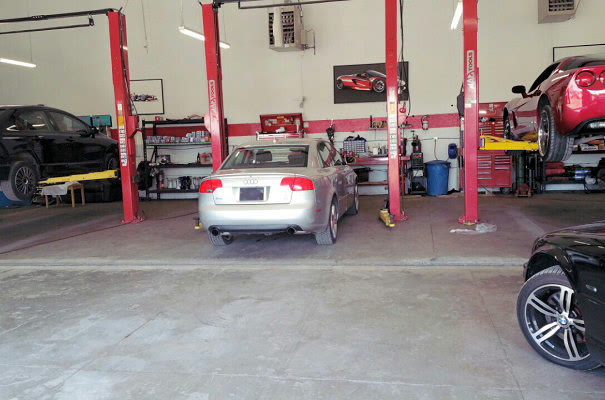
Book it whenever suits you
Pick a time on the booking page, tell us what the car is doing and add a few photos. Bring it to Marchand Street by 9am on the day you chose, and we call you before any work starts.