How much is a brake job
A brake change at 2 and 1/2 Mechanics starts at $180. What that covers, what pushes it up, and why salted Ottawa cars rarely need just pads.
The short answer
At 2 and 1/2 Mechanics, a brake change starts at $180, before tax, and the final number depends on the vehicle. Anything beyond a straightforward job is priced once the car is up on the lift and we can see what it actually needs. That second part is where most of the difference between two brake jobs comes from.
We don’t quote parts over the phone for a reason. Two cars of the same model can roll in after a few Ottawa winters with very different brakes. One needs pads. The other needs pads, rotors and a caliper that has seized on one side.
What a brake change includes
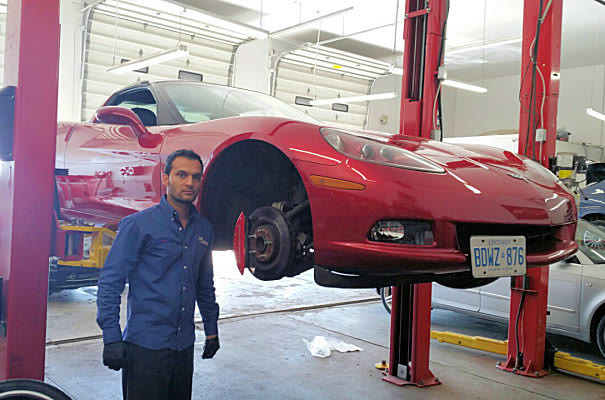
A brake job here starts with the wheels off and a measurement, not a guess. On each axle we look at:
- pad thickness on both the inner and outer pads, since the inner pad often wears faster and you can’t see it through the wheel
- rotor thickness and the condition of the braking surface, including rust pitting and the lip at the outer edge
- caliper slide pins and the brackets the pads ride in
- the hardware clips that hold the pads, which rust and bind
- brake hoses for cracks and bulges, and the steel lines where they can be seen
- brake fluid level and condition
Then we call you with what we found, what it costs and what can safely wait. Nothing gets replaced until you say yes, and the old parts are kept so you can see them when you pick the car up.
When the job goes ahead, doing it properly means scraping the rust off the brackets where the pads sit, lubricating the slide pins, fitting new clips where the old ones are tired, and bedding the new pads in on a road test. Skipping the cleaning is the usual reason a cheap brake job squeals or wears unevenly within a season.
Pads, rotors and calipers on a salted car
Brake parts in this city don’t only wear out. They rust out, and on plenty of Ottawa cars that happens before the pads are anywhere near worn down.
Pads are the part people expect to replace. On a car that spends its days in stop and go traffic on St. Laurent Boulevard, they go faster than on one that mostly cruises the 417 or the 174. Salt adds its own problem. Rust builds up under the pad backing plate and inside the bracket, the pad gets squeezed, and it starts to stick or drag.
Rotors are the next question. A rotor can measure thick enough and still need replacing, because salt has eaten into the surface or the outer band has rusted while the middle stays shiny. Rear rotors on cars that do most of their braking up front are the usual victims. New pads on a pitted rotor will be noisy and won’t stop as well, so we tell you that instead of fitting pads alone and hoping.
Calipers are where salt does the expensive damage. A seized slide pin or a sticking piston keeps one pad pressed against the rotor. You get a hot smell after a drive, a pull to one side, one wheel much hotter than the others, and a pad worn down on one side only. Putting new pads in without fixing the caliper means doing the job again in a few months.
What moves the price
The $180 starting point is a straightforward job. These are the things that push it up:
- the vehicle itself, since a large SUV or a pickup has heavier parts and more to take apart
- doing both axles instead of one
- rotors as well as pads
- a seized caliper, slide pin or bracket bolt that has to be freed or replaced
- an electronic parking brake, which on many newer cars has to be put into service mode with a scan tool before the rear pads can go in
- brake lines that crumble when they are touched, common on older cars that have seen a lot of salt
- a brake fluid flush, if the fluid is old or has absorbed water
Parts prices vary as well, and there is usually more than one grade of pad and rotor for any given car. We tell you the options and which one we would put on our own car. You pick.
Signs it’s time
You don’t have to wait for grinding. Book a look if you notice any of these:
- a high squeal that comes and goes, which is often the wear indicator touching the rotor
- grinding, which usually means the pad lining is gone and metal is meeting metal
- a pulsing pedal when you slow down from highway speed
- the car pulling to one side under braking
- a pedal that feels soft or sinks slowly at a red light
- a burning smell from one wheel after a drive
If the pedal goes close to the floor, or the red brake warning light stays on, don’t drive the car. Call (613) 741-9696 before you go anywhere and we’ll talk it through.
A note on timing
A lot of people have the brakes looked at when the winter tires go on in late October or November, since the wheels are coming off anyway. It is a good habit. Worn rear pads in November usually turn into seized hardware by March, and a short repair becomes a longer one.
If your car is already booked for a tire swap, write the brakes into the booking notes and ask us to measure them while the wheels are off. You can attach photos too, like a pad you can see through the spokes that looks thinner on one side, when you book online. The shop is open Saturday 8am to 3pm, which helps if weekdays are hard, and drop off is by 9am on the day you book.
There is more detail on the brake repair page. If the car also clunks over bumps or wanders on the highway, the cause may be in the suspension and steering rather than the brakes. And if nobody can remember the last time the brake fluid was changed, ask about it with the rest of our fluid services.
Related work
Book it whenever suits you
Pick a time on the booking page, tell us what the car is doing and add a few photos. Bring it to Marchand Street by 9am on the day you chose, and we call you before any work starts.